DAVID BELLAMY: HAPPY CHRISTMAS

It feels very un-Christmassy here in rain-drenched Pembrokeshire at the moment while I’m recovering from a fairly mild dose of ‘flu, and I’ll need to be in top form next week when my two over-active grand-daughters arrive. Jenny will be safely ensconced in Hampshire with her ‘little’ ones while I face the full force of furious chaos.

A fall of snow would help of course, with the distraction of building a snowman while I sneak in a quick watercolour sketch if I’m lucky. Plotting it is fairly easy as I can take the girls up handy toboggan slopes at the same time and where the mountains are in full view. The attached watercolour of the Black Mountains gives an idea of what can be done reasonably quickly. In cases like this where speed is vital then watercolour pencils are truly effective.
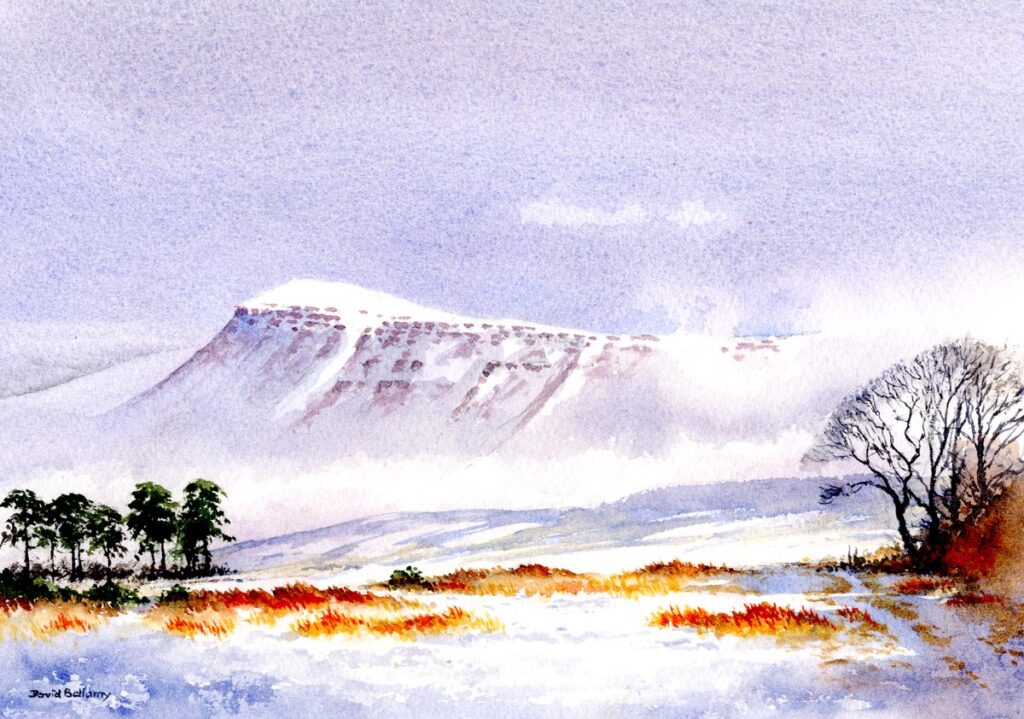
Note how the track on the right-hand side has been defined in the snow with intermittent stabs of the brush to suggest a winding effect. For this I used transparent red oxide, and also floated it into the dark mass under the trees while this was still wet. The background at this point has been kept simple with just a stroke or two of a wash brush, and the mountain ridge at the top has been lost in cloud in places. These are all really simple techniques which use the watercolour medium to advantage. This has been painted in the studio on Saunders Waterford 140lb NOT paper, but in a sketch these effects can be achieved in two or three minutes with watercolour pencils, working freely without any need to create a complete landscape composition.

Enjoy your Christmas and have a great time. I wish you every happiness for Christmas and 2026 and evry success with your painting.

DAVID BELLAMY: RAPID SKETCHING

This is a time of year when many of us go off on holiday with friends, family or on guided tours with others, hoping to snatch a sketch or painting here and there, only to find that we are pressed to move on quickly to the next highlight of the trip. So we don’t get our sketch, just a quick photo which often falls short of our needs. How do we respond to these pressures?

Having to cope with some furious sketching moments when an Arctic storm is almost upon me, or something really nasty has just emerged from out of the jungle to threaten my very existence, I’ve developed rapid-sketching methods over the years. Firstly, make sure you prepare well. Have your gear ready to hand: fiddling with the opening of pack buckles and searching for the right pencil in a deep container takes precious time, so apart from my usual painting kit kept in a rucsack I ensure I have sharpened pencil stubs in my pockets and an A5 sketchbook in another, all ready to grab quickly and start working. Also included in this pocket kit are water-soluble pencils and an Aquash brush containing its own water supply.

This is a pencil sketch in an A5 hardback sketchbook I did in Austria a couple of weeks ago. It shows the Durlasbodenstausee in the Eastern Tyrol, a magnificent scene, but I only had around 5 minutes to render it. I began with a few photographs, not just of the general scene, but also a close-up of the Reichenspitze, the handsome reigning peak. However, as in many cases I needed to ensure I recorded those parts of the scene that would be less clear in a photograph, and also bring in one or two conifers into more prominent positions than where they stood in reality.

To work quickly within such a ridiculously short time-frame I used my pencil-stubs, ignored the larger sketchbooks in my rucsack and worked over a double-page spread on the A5 book. I briefly indicated the darker tones on the sky only in a small area on the left where it abuts the snow slopes of the Gabler running down on the left, and also put in small patches of dark tones where there was darker ground than the glacier and also where the dark conifers stood. I then darkened the lake in places to indicate the water was darker than the shorelines. Finally I introduced the foreground trees on the left, but only with 3 or 4 pencil lines.

That evening in the hotel I added tone to the mountain peaks and sky, also darkening the top of the sky to include the stormy clouds, then worked on the slopes and conifers, all within the rapid outlines I had created on the spot. I had made a note of one or two of the more important colours, such as the shorelines, but for a painting I often impose my own colour regime anyway. I am wary of doing too much to a sketch, as it’s best to retain the spontaneity of the original, but when working under these conditions you do need to try to produce a reasonable response to the scene while it is still fresh in your mind.

Note that you can buy pencil extenders and also point protectors for those stubs. I always have a few of these in my pockets, even in a restaurant or cafe – you never know when you might need them!

David Bellamy : The Value of White Gouache

Featured

DAVID BELLAMY: THE VALUE OF WHITE GOUACHE

This is the time of year when many get out their sketching gear ready to go on holiday and enjoy some artwork in a new place. I always take my box of watercolour pans along with me, mainly for watercolour sketches, though sometimes I work on a full painting out of doors. For certain subjects it’s actually quicker working in watercolour than trying to render the subject in pencil or pen.

In addition to the half-pan colours I carry a few tubes of watercolours, and these are usually colours that I don’t have in my box but I expect to be useful for a particular trip. A secondary reason is that if I happen to lose my box of paints at least I have the tube colours to fall back on. One tube I always take is that of white gouache, as it is so useful. As well as being essential for tinted papers it is great for little highlights or perhaps rectifying part of the work that has gone astray.

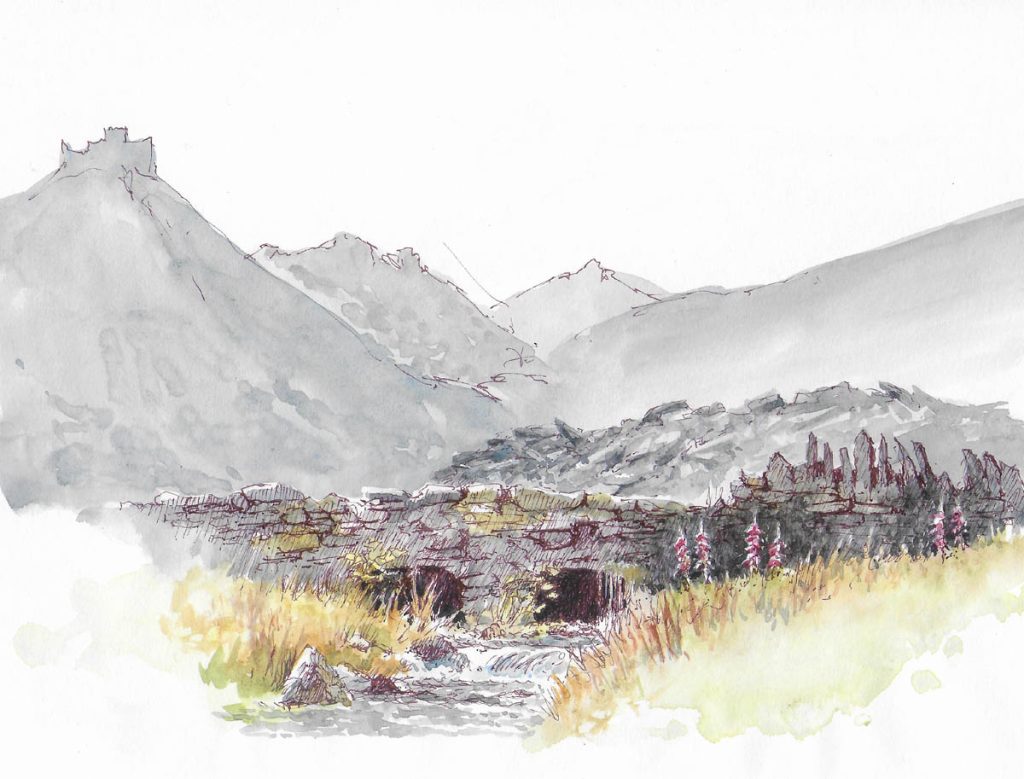
I sketched this stone bridge last week in Cwmorthin, a slate-quarrying area near Blaenau Ffestiniog, and you can see the piles of slate heaped up behind the bridge, as well as mountainous slate slag-heaps in the distance. Those I only indicated vaguely, as the bridge was my main objective. I drew this with a sepia pen and wanted to highlight the foxgloves as they broke up the stonework and added colour to the scene. Alas, I messed this up a bit. One of the difficulties we have as landscape artists is that we don’t have the great range of tones that occur in nature, so we have to modify our tones a little. My foxgloves weren’t too bad, but I felt they could stand out better, so I applied white gouache over them and then when that was dry overlaid alizarin crimson over the gouache. This certainly made them stand out more, and although they are far from perfect I do have a reasonable sketch from which to work up a painting. So it’s always helpful to have a tube of white gouache with you on your travels.

On Saturday I shall be book-signing at Erwood Station Gallery & Craft Centre, about 8 miles south of Builth Wells just off the A470, from 2 to 4 pm. I will also be showing quite a number of the painting from the new book, Watercolour and Beyond, with captions on certain techniques and effects in the painting, and I’ll be happy to answer any queries you may have about painting landscapes, so do come along if you can make it. It’s a lovely spot overlooking the River Wye. Their phone number is 01982 560555. The paintings will be on display throughout July, so if you can’t make it on Saturday they will be around for a while. And incidentally, the book covers quite a bit about working with gouache paints. Enjoy your summer travels and keep safe!

DAVID BELLAMY Tonal Sketching a Landscape

Welcome to my first blog of 2025 and I wish you all a rather belated Happy New Year. May you have much success with your paintings!

As you may know, I am very keen on sketching, both for the sheer enjoyment of sketching a scene amidst nature, and for recording a composition to work up as a painting back in the studio. On expeditions, holidays and trips they are also marvellous ways of retaining memories of activities, people and places.

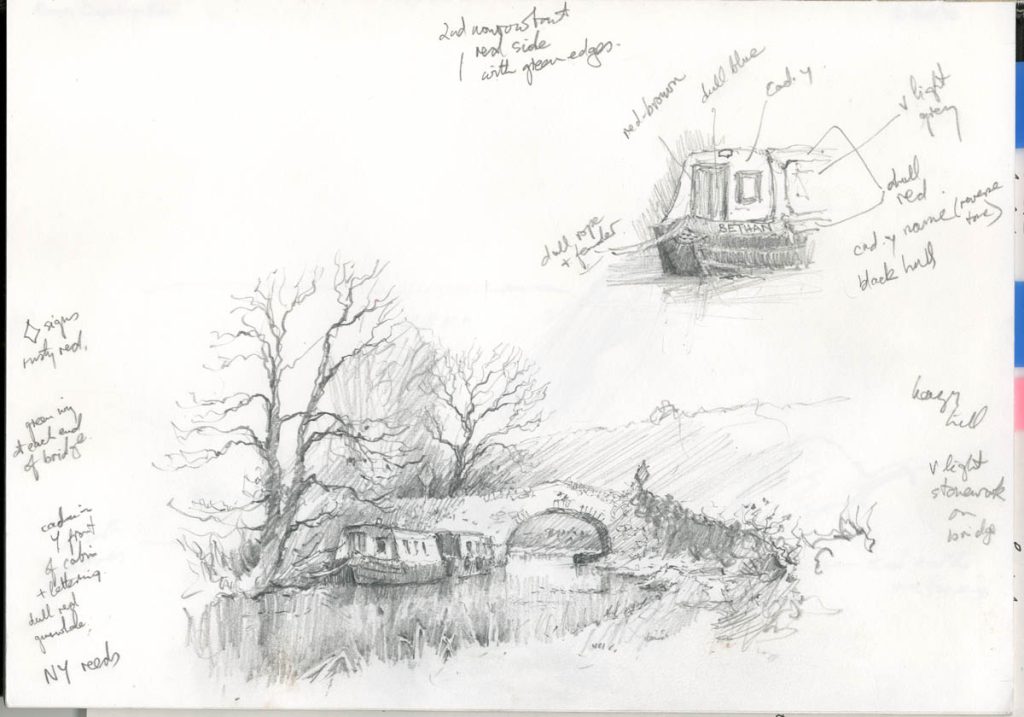
This time I’d like to highlight the benefits of tonal sketching in pencil, that is, where you include a lot of tonal areas rather than simply rely on a linear approach. This canal scene illustrates how the dark areas bring out the shape and character of the bridge, the trees and boats, while the medium tones both link the light and dark features and suggest detail and minor shapes. These medium tones become very important in an atmospheric sketch where you may be depicting mist, cloud, sunshine and other less strident features. I used a 4B pencil on a page of A4 size cartridge paper.

As you can see, in this case I have liberally noted down colours and at the top right drawn a larger version of the prow of the narrow-boat so that certain small details become clearer. This is useful if I will be working up a large painting later. Apart from the fact that you are recording the scene in detail and gaining an understanding of it, some details of which might become lost in a photograph of the place, you are laying out a ready-made composition and will probably not need to do a studio sketch from the photograph to ensure that everything is as you wish for in the finished painting.

You may have already seen the new merged Leisure Painter and The Artist magazine, which is packed with great information and illustrations. With so many publications now turning to digital versions I feel it’s so good to support the paper versions – I’m not so happy messing about on small screens! I have an article in the current issue on sketching during my trip to Transylvania last summer. Don’t forget to keep warm when you are out sketching!

David Bellamy: The value of drawing

Many of us are so eager to start painting that we tend to gloss over the need to get the drawing right before our brush touches the paper, and then we wonder why the composition doesn’t work too well. I love drawing, and drawing and doodling are a wonderful therapeutic activity, ideal for calming one after the stresses of modern living. I take my sketching in the field very seriously, even when I may have no need for any more sketches to add to the thousands already done.

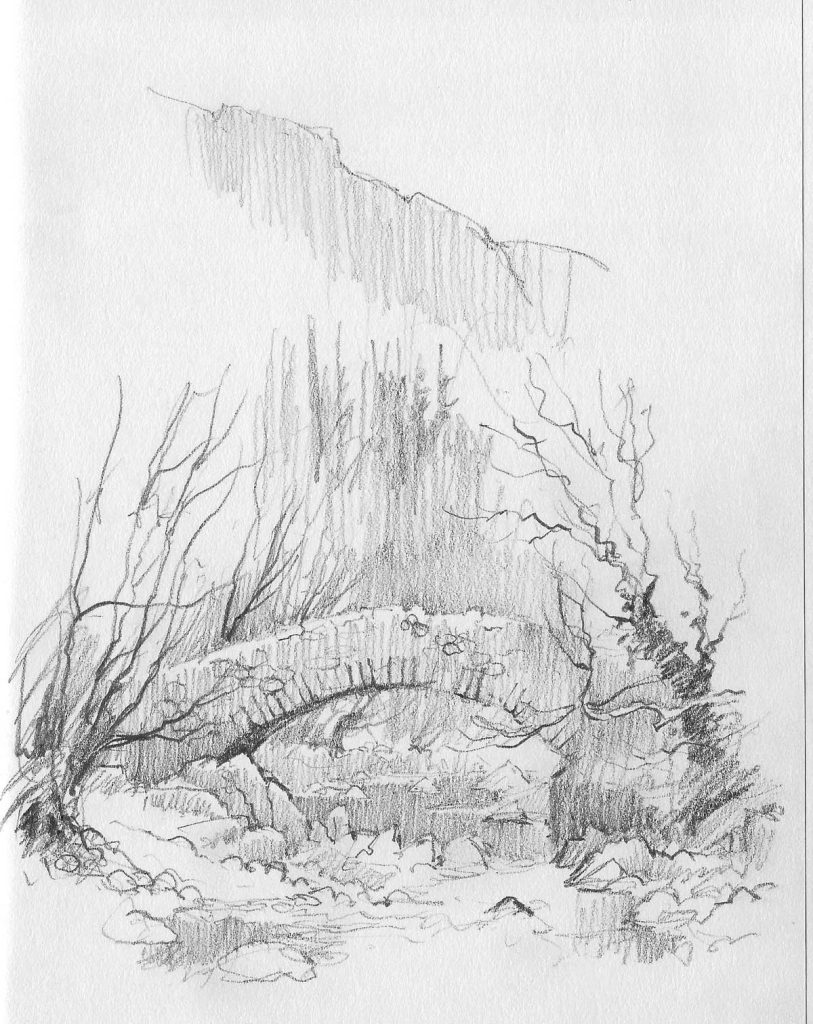
This is a sketch of the attractive old Doctor’s Bridge in Eskdale. Although not completely finished, it illustrates several vital points for landscape artists:

  • By carrying out a sketch you are already arranging the composition for a subsequent painting and working out everything you need for the finished result;
  • Sketching is the ideal time to assess the major tonal values in a scene- how dark? how light? do any features benefit from an adjustment of tones?
  • More than anything else you are learning to observe, learning how to draw and seeing how different aspects of the scene relate to each other;
  • Note the cursory manner in which the background has been rendered. If you need to work quickly this kind of treatment is useful for the less important parts of a composition.

Getting the drawing right is especially vital with watercolour painting, so do try to practice this as often as you can. It will have a great impact on your painting.

This summer has been especially hectic, culminating disastrously when I experienced a heart attack at the beginning of September. Luckily in just over an hour after ringing for an ambulance I was on the operating table witnessing the whole operation as they cleared the blockage in an artery. The NHS staff were brilliant and deserve the highest praise. Please be aware that if you get chest pain that runs down into your arms and perhaps up to your jaw you need to get help quickly – don’t delay! And don’t forget, the power of art is quite amazing. Sketching is a wonderful way to de-stress and relax you. I can’t recommend it highly enough.